
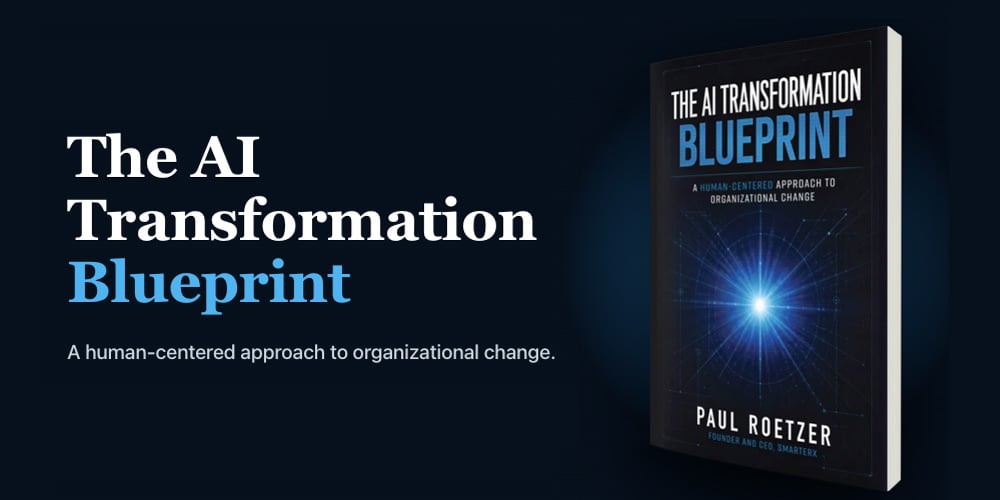
Join Paul Roetzer for an AI Academy Book Club conversation about his new book, The AI Transformation Blueprint, and what it really takes to drive meaningful, human-centered change.
Your organization has invested in AI tools. Employees are experimenting with LLMs and other AI applications. You've launched pilots, introduced policies, and maybe even established an AI Council.
But here's a question worth asking: Is all that AI activity actually leading to transformation?
It's one thing to adopt AI. It's another to fundamentally rethink how your organization operates, how people work, and how you create value.
And while AI adoption is relatively easy to track, measuring meaningful transformation is much more complicated.
What does success actually look like? How do you know if you're making progress? And perhaps most importantly, how do you move forward without losing sight of the people at the center of that change?
These are the questions at the heart of The AI Transformation Blueprint: A Human-Centered Approach to Organizational Change, the new book from Paul Roetzer, founder and CEO of SmarterX.
And they're exactly what we'll explore in our next AI Academy Book Club.
A Blueprint for Moving Beyond AI Experimentation
AI is changing how we work at an extraordinary pace. Yet for many professionals and organizations, there's a growing gap between experimenting with AI and realizing its full potential.
That's the challenge Paul set out to address.
In The AI Transformation Blueprint, he introduces the AI Transformation System (AITS), a practical approach to helping individuals and organizations move from AI understanding and experimentation toward measurable, sustained transformation.
At the center of the book are two connected frameworks:
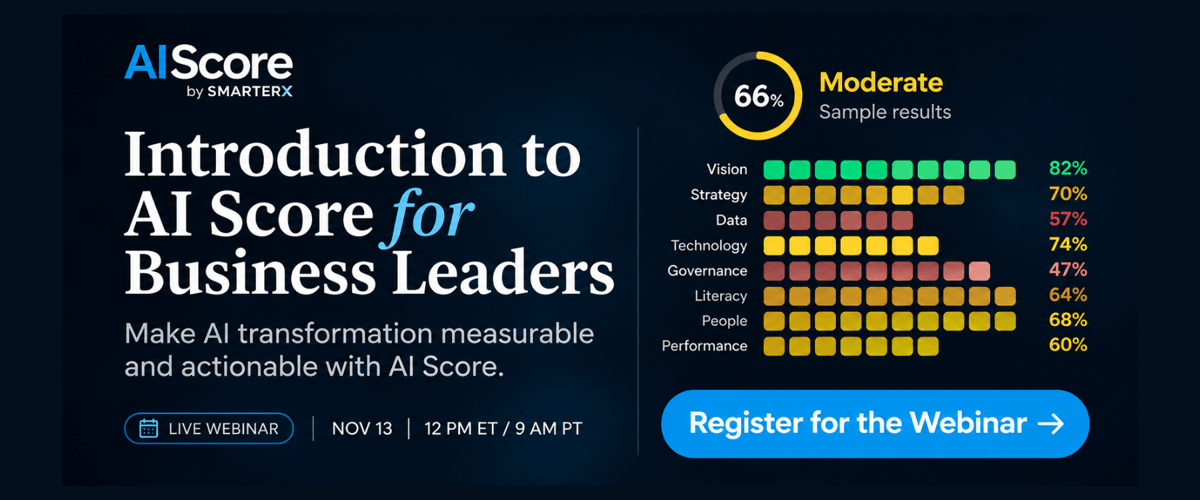
- The Business AI Transformation Blueprint examines eight essential pillars: Vision, Strategy, Data, Technology, Governance, Literacy, People, and Performance. Together, they provide a way for leaders to evaluate organizational readiness, identify gaps, and prioritize meaningful change.
- The Personal AI Transformation Blueprint focuses on five pillars: Knowledge, Application, Judgment, Impact, and Mindset. It challenges individuals to think beyond learning new tools and consider how AI is changing their capabilities, decisions, work, and careers.
The central premise is simple but powerful. Every organizational transformation is a collection of individual transformations.
After all, an organization can have an ambitious AI strategy, sophisticated technology, and extensive training programs. But if its people aren't developing the confidence, capabilities, and judgment to work differently, how much has really changed?
The book also introduces companion assessments designed to help individuals and organizations establish a baseline, identify opportunities, and measure progress over time.
Rather than offering a one-size-fits-all prescription, the Blueprint invites readers to evaluate their own starting point and determine what transformation should look like in their unique circumstances.
Explore The AI Transformation Blueprint and Get Your Copy
What Does Human-Centered AI Transformation Really Require?
There's another important dimension to this conversation.
AI promises extraordinary gains in productivity, efficiency, and innovation. But realizing those opportunities will also require difficult decisions about jobs, skills, leadership, and organizational culture.
How do leaders balance the urgency to move faster with the responsibility to support their people?
What happens when employees are ready to embrace AI, but their organizations aren't?
And as AI becomes increasingly capable, how do we ensure that human judgment, trust, and accountability remain central to the transformation?
As Paul writes in the book's epilogue:
“AI should unlock human potential and creativity, not replace it.”
— Paul Roetzer, The AI Transformation Blueprint
It's a powerful reminder that AI transformation isn't just a technology challenge. It's a human one.
The real opportunity isn't simply to automate existing work or introduce more sophisticated technology. It's to rethink what's possible when people are equipped with new capabilities, supported by thoughtful leadership, and empowered to work in entirely new ways.
But putting that vision into practice isn't always straightforward.
It requires intentional leadership, continuous learning, and a willingness to challenge long-established ways of working. It also requires navigating the very real tensions between business performance, workforce change, and responsible AI adoption.
That's why this book is especially relevant for executives, transformation leaders, AI Council members, learning and development professionals, and anyone navigating AI-driven change in their career.
Join the Conversation with Paul Roetzer
On Tuesday, Dec. 1, 2026, from 12–1 p.m. ET, join AI Academy Live for a Book Club conversation featuring my discussion with Paul Roetzer.
Rather than simply walking through the frameworks in the book, we'll go deeper into the realities, challenges, and opportunities of AI transformation.
Together, we'll explore questions including:
- The transformation test: What evidence tells us an organization is truly transforming, rather than simply adopting more AI tools?
- The human factor: Why must individual and organizational transformation happen together? What happens when one moves faster than the other?
- The leadership challenge: How can leaders balance urgency, measurable performance, and responsible, human-centered change?
- The path forward: When assessments reveal numerous gaps and opportunities, how do you determine what matters most to tackle first?
We'll also explore what Paul learned while developing the Blueprint, where organizations commonly get stuck, and what it really takes to turn a transformation strategy into sustained progress.
Whether you're leading AI initiatives across an organization or figuring out what transformation means for your own career, this conversation is designed to help you think more critically about where you are, where you want to go, and what it will take to get there.
Read the Book. Join the Discussion. Start Your Transformation.
As we look ahead to 2027, there's an important question every leader and professional should be asking:
If your AI transformation efforts are successful over the next 12 months, what will be visibly different?
Not just how many tools you're using, how many employees have completed training, or how many pilots you've launched.
What will actually change for your people, your customers, your organization, and yourself?
“Don’t wait for the world to get smarter around you. Choose to learn, grow, and evolve.”
— Paul Roetzer, The AI Transformation Blueprint
Transformation doesn't happen simply because technology advances. It happens when people make intentional choices about how to adapt, lead, and create something better.
And whether you're a business leader responsible for organizational change or an individual looking to shape your own future, you have an opportunity to be part of that transformation.
We encourage you to pick up The AI Transformation Blueprint before the event, reflect on what transformation means in your own context, and bring your questions to the conversation.
You don't need to have all the answers. That's what makes this an important conversation to have together.
Event Details
AI Academy Book Club: The AI Transformation Blueprint
- Date: Tuesday, December 1, 2026
- Time: 12–1 p.m. ET
- Featuring: Paul Roetzer, Founder & CEO, SmarterX and author of The AI Transformation Blueprint
- Hosted by: Jessica Miller, Head of Learning, AI Academy
Register for the AI Academy Book Club
Get Your Copy of The AI Transformation Blueprint
The book provides the blueprint. The conversation explores the challenges. The next step is yours. “The future is human + AI. And the future is now.” Shop Now.
Jessica Miller
Jessica Miller is the Head of Learning for AI Academy by SmarterX